Blog


Why Cat Eye Genealogy?

Cat Eye Genealogy represents my love of cat eye glasses (I have a significant collection of magnetic frames) as well as my perspective on all things genealogy.

My blog will feature articles on genealogy tips and resources, my family’s history, eyewear, and my fur family. It represents my personal point of view and does not represent the opinions of any other person, group, organization, or institution.

Finding Foreign Origins, Part 2: Social Security Records

The Social Security Applications and Claims Index, 1936-2007

A quick place to check for the foreign place of birth of an immigrant who lived well into the twentieth century is the Social Security Applications and Claims Index. The Claims index, also known as Numerical Identification Files (NUMIDENT) usually includes place of birth, father’s name, mother’s maiden name, date of birth, date of death, race, social security number, and name changes.

This index is comprised of some individuals who died between 1936 and 2007 who also had signed-up for Social Security. The database is most complete for those who died in or after 1962, which is when the Social Security Administration began computerizing death information.

The information in the database comes from social security applications (SS-5), social security claims, and social security death entries. For more detailed information about the compilation of this database, see the National Archives’ document “Frequently Asked Questions (FAQs): Numerical Identification (NUMIDENT) Files, Record Group 47.”

The Social Security Applications and Claims Index is freely accessible on the National Archives website in the Access to Archival Databases (AAD) and on FamilySearch. It is also available in Ancestry.com.

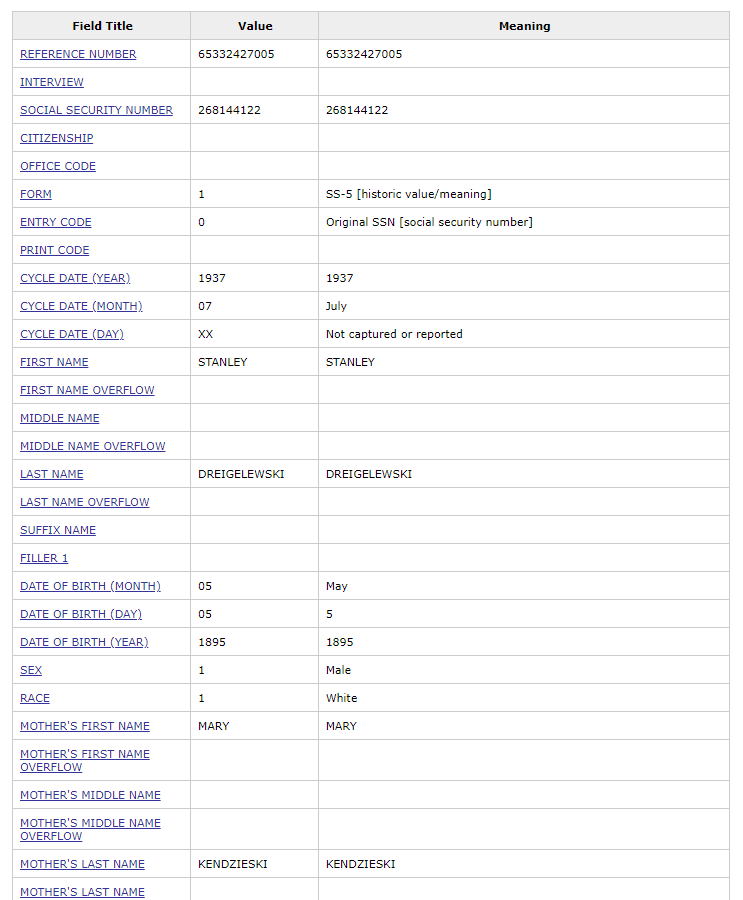
Example NUMIDENT entry from the AAD (split in two parts):

Social Security Applications (SS-5)

If your deceased ancestor is not in the Claims Index, or you would like a copy of the original social security application (SS-5), you can make a Freedom of Information Act (FOIA) request. Currently, there is a $30 fee to receive a copy, but it generally only takes a few weeks to receive a scan of the document.

The application typically includes place of birth, father’s name, mother’s maiden name, date of birth, race, social security number, employer, and the applicant’s signature. Parents’ names will be redacted if the individual whose application you are requesting would have been under 100 years old at the time of your request.

Finding Foreign Origins, Part I: Narrowing Down Immigration and Naturalization Dates

One of the most common questions I am asked as a genealogy librarian is —Where were my immigrant ancestors from?

To answer this question, it is helpful to narrow down your ancestor’s immigration and naturalization dates.

U.S. Federal Census Records

The 1890 through 1930 U.S. federal census records include important immigration data. The following questions were asked.

1890 Census

All but 1% of the 1890 census was burned in a fire. If you are lucky and your ancestor’s record survived, you may find the following information.

  • Number of years in the United States
  • Whether naturalized
  • Whether naturalization papers have been taken out

1900 Census

  • Year of immigration to the United States
  • Number of years in the United States
  • Naturalization

1910 Census

  • Year of immigration to the United States
  • Whether naturalized or alien

1920 Census

  • Year of immigration to the United States
  • Whether naturalized or alien
  • If naturalized, year of naturalization

1930 Census

  • Year of immigration to the United States
  • Naturalization

To understand the data which was to be recorded, see the census instructions. Don’t take the dates recorded as written in stone. Memories can fade and the person providing the information to the census taker may not be the immigrant.

For information on accessing the U.S. Federal Census, see the FamilySearch Wiki.

State Census Records

Some states took their own censuses in addition to the federal censuses. New York State took censuses in 1825, 1835, 1845, 1855, 1865, 1875, 1892, 1905, 1915, and 1925. New York State census records are readily accessible online.

1892 New York State Census

  • Citizen or alien

1905 & 1915 New York State Censuses

  • Number of years in the United States
  • Citizen or alien

1925 New York State Census

  • Number of years in the United States
  • Citizen or alien
  • If naturalized, when and where

The First Piece of U.S. Evidence

If your ancestors died before the relevant censuses (above), a good strategy is to gather all of the documents that you’ve collected about your ancestor and their close family. The date of the earliest document created in the United States can serve as an “arrived by” date, which will narrow down your search for immigration records.